Phase-change storage
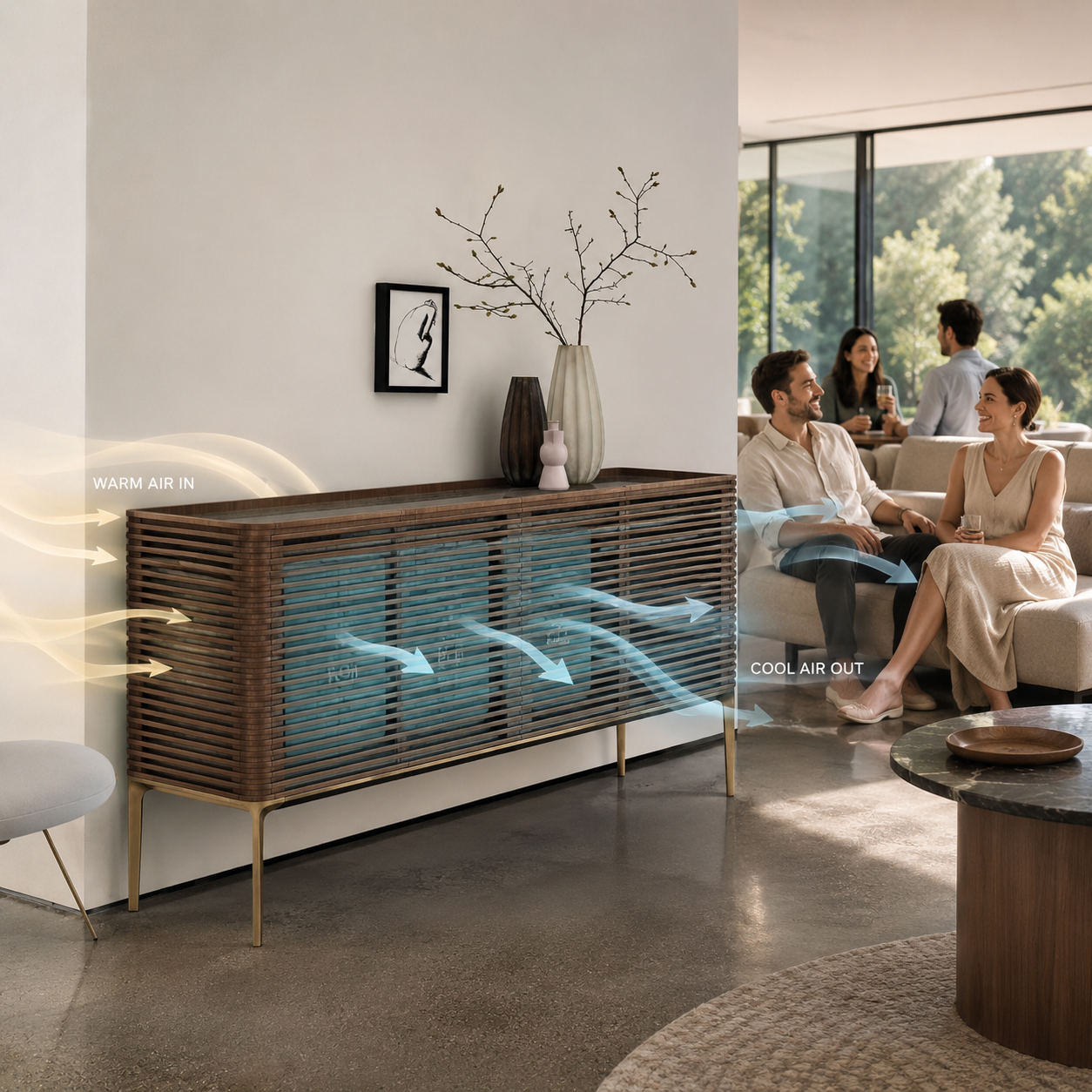
Shape-stabilised PCM absorbs and releases heat around a target temperature zone without free liquid leakage.
Edge Comfort builds on the Passive Edge PCM platform, which solves two hard parts: shape-stabilised PCM that does not leak, and high-conductivity paths that move heat in and out fast enough to matter in a DIY retrofit.
International team
Edge Comfort is an international company shaped by product designers, artists and scientists. Our team brings perspectives from the United States, Germany and China.
Shape-stabilised PCM absorbs and releases heat around a target temperature zone without free liquid leakage.
The core challenge is not only storing coolth, but moving heat in and out fast enough to matter through high-k fins.
When outdoor night air is cool enough, fans and airflow channels help recharge PCM modules.
During the day, PCM absorbs indoor heat and helps extend comfort hours.
Performance depends on context
Passive PCM cooling depends on local night temperatures, humidity, solar gain, ventilation behavior and building fabric. That is why Studio first sizes PCM modules and then maps reuse parts, partner picks and optional off-peak recharge around the real room.
The platform is not cooling-only: PCM modules come in six phase-change temperatures — 22 / 24 / 26 / 28 / 30 / 32°C — so Studio can match the room, climate and recharge strategy. And because PCM absorbs and releases heat at a nearly constant temperature, it damps indoor swings — rooms hold a steady, comfortable band around the chosen zone instead of cycling hot and cold.
Explore the PCM platform at passive-edge.tech →